Analysis · New formats
Shingyotai: how Japanese chains test a new concept
Pancho, Mos Burger, FamilyMart: six chains opened a new format in Tokyo in one year. How they test a concept, and what a foreign brand can take from it.
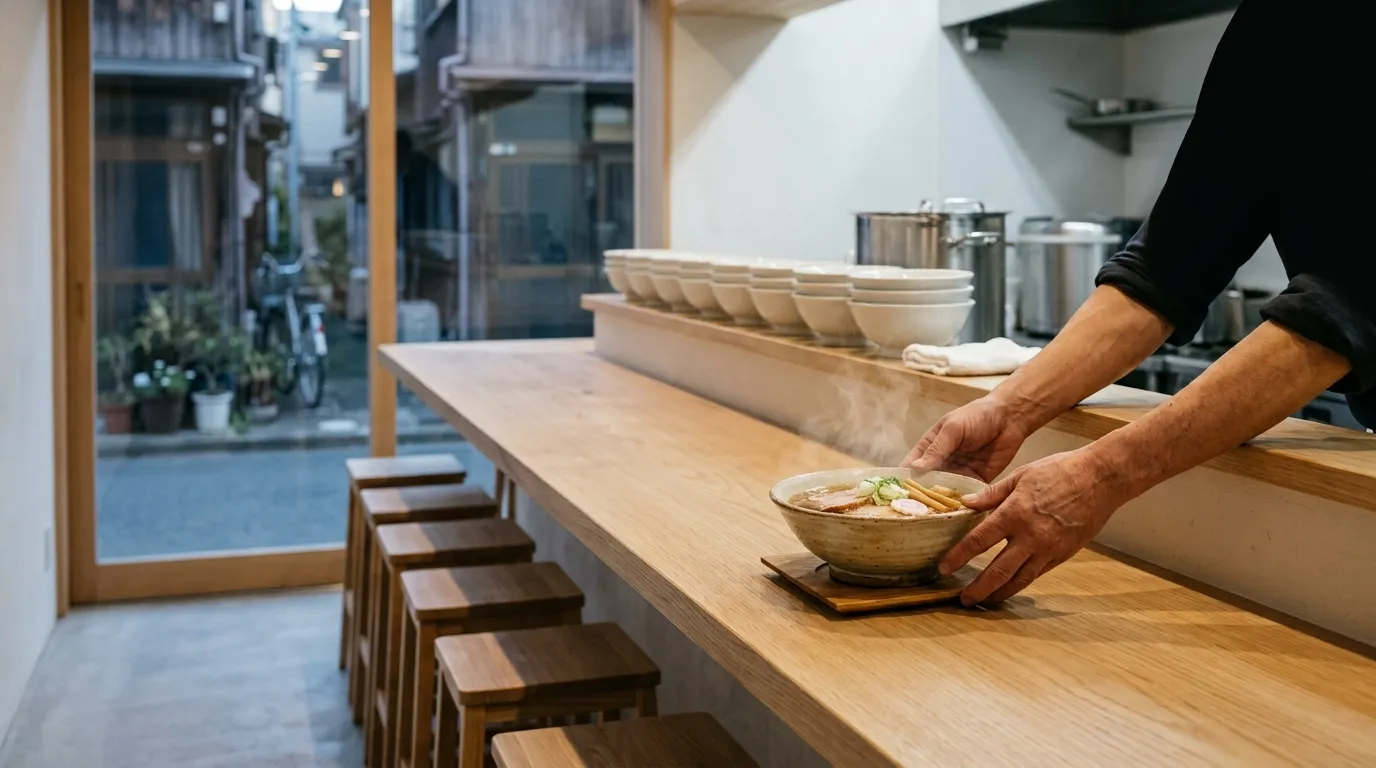
On October 2, 2026, Pancho, the Napolitan spaghetti chain with 51 locations, opened its first Gochisou Soup Pasta in Yoyogi: eleven soup pastas, 25 seats, from ¥1,419 to ¥1,749. On October 5, GOSSO, which runs 20 champon restaurants, opens an everyday ramen counter in Shinagawa at ¥858 a bowl.
Key takeaways
In Japan, this move has a name: shingyotai (新業態), the "new format". A chain that wants to test an idea opens a single location under a different name, often in Tokyo, and checks that the concept finds its customers before rolling it out.
- Six new formats in one year: between December 2025 and October 2026, at least six chains opened a new format in Tokyo, from Pronto in Ginza to FamilyMart in Azabudai.
- Know-how from the parent brand: almost every test starts from an existing technique, the broth, the grill, the counter. The product changes; the technique stays.
- One location, a small room: 22 to 66 seats for the restaurants, and one location is enough to judge.
What is a shingyotai?
A shingyotai is a new type of venue launched by a company that already runs one or more brands. The term is common enough to have its own keyword page on PR Times, Japan's main press release platform.
The new format can change the product, the opening hours, the target customer or the location. It almost always keeps something from the parent company: suppliers, a technique, the kitchen team, the brand. That is what separates it from a concept built from scratch.
Six new formats opened in Tokyo in one year
| New format | Opening |
|---|---|
| PRONTO THE FIRST (Pronto), Ginza: specialty coffee downstairs, espresso bar upstairs after 5 pm, 66 seats | Dec 2025 |
| MOSH Burger & Bar (Mos Burger), Ginza: burgers by day, bar at night, cheeseburger set at ¥1,380 | Jul 2026 |
| Famima Park (FamilyMart), Azabudai: a "destination" konbini designed with NIGO, 217 m², clothing, fitting rooms | Jul 2026 |
| Le Logis Beau (Four Star), Nishi-Ikebukuro: charcoal bistro in a 60-year-old house, 44 seats, ¥6,000 to ¥7,000 per person | Oct 2026 |
| Gochisou Soup Pasta (Pancho), Yoyogi: eleven soup pastas, 25 seats including 9 at the counter | Oct 2026 |
| Chuka Soba Jigemon-ken (GOSSO), Shinagawa: everyday ramen at ¥858, 22 seats, office district | Oct 2026 |
The six groups made the same choice: one location each, in very different neighbourhoods. Ginza for the two formats that come alive at night, Shinagawa Season Terrace for office lunches, Azabudai for the konbini FamilyMart wants to make appealing to international visitors. Their tests follow three methods.
Add a service in the same space
The first method extends the day of a format that already works. Pronto rebuilt its very first shop, opened in 1988 on Namiki-dori: the ground floor serves drip coffee all day, and the upper floor becomes an espresso bar after 5 pm, with an espresso martini at ¥1,650.
Mos Burger follows the same logic in Ginza. MOSH Burger & Bar serves eight burgers during the day, then cocktails and small plates at night, until 11 pm on Fridays. In a district where rent is expensive, a venue that takes money at lunch, after work and after dinner uses its square metres for longer.
It is not Mos Burger's first attempt. In November 2022, the chain opened mosh Grab'n Go in Minami-Azabu, a counter selling three cheeseburgers, which closed in October 2024 after two years. The Ginza format picks up the idea and adds an evening service.
Keep the know-how, change the product
The second method starts from what the kitchen already does well. Pancho knows its sauces and its pasta: Gochisou Soup Pasta serves the pasta in broth, and offers to finish the bowl with a cheese risotto made in the leftover broth. In Japan this gesture has a name, shime, the closing course of nabe hot pots and ramen. Pancho builds on a habit its customers already have.
GOSSO does the same with champon, the Nagasaki dish stir-fried in a wok and served in a rich broth. According to its press release, the new Shinagawa counter applies that high-heat stir-fry and broth know-how to a simpler bowl meant to be eaten every day: ramen or tanmen at ¥858, served from 10:30 am to 9 pm on weekdays.
Four Star, which mostly runs oyster bars, opened Le Logis Beau, a charcoal bistro. Oysters stay on the menu, baked with escargot butter at ¥1,650, next to a grilled wagyu at ¥3,850 and around fifty wines.
Turn the store into a destination
The third method changes the reason to come. Famima Park, opened on July 10, 2026 in Azabudai, is a FamilyMart that customers visit for its own sake: designed with creative director NIGO, it sells the Convenience Wear clothing line with product advisors and fitting rooms, has a takeaway stand open to the street, and a planted rooftop.
FamilyMart states the goal in its press release: roll out to the rest of the network what works in Azabudai. The chain uses the store as a test site for its whole network.
Why small, and why Tokyo
A test format stays small because it answers a precise question about the product and the customer. The restaurants in the table range from 22 seats (Shinagawa) to 66 (Ginza). A small room costs less to fit out, and shows early on whether customers come back.
Tokyo concentrates these tests because the city brings together very different customers within a few kilometres: Shinagawa's offices, Ginza's nightlife, the residential districts to the west. A chain picks the neighbourhood that matches the customer it wants to test.
What a foreign brand can take from this
Japanese chains apply to themselves the method we recommend to brands arriving in Japan.
- A first location is a pilot: it is there to check a price, a menu, opening hours and a customer base before committing to several locations or a large flagship.
- The concept builds on what customers already know: Pancho brought shime into a pasta bowl; Pronto and Mos Burger used the café-to-bar switch that Tokyoites know well. A foreign brand gains from finding the local habit that makes its product feel obvious.
- Work on the quiet hours: a venue that serves lunch and dinner, or two concepts sharing the same space, pays Tokyo rent more easily. It is one of the first things we look at when we cost a project with a brand.
Sources
- Pancho, press release on the opening of Gochisou Soup Pasta in Yoyogi, PR Times, September 2026
- GOSSO, press release on the opening of Chuka Soba Jigemon-ken in Shinagawa, PR Times, September 2026
- Four Star, press release on the opening of Le Logis Beau in Nishi-Ikebukuro, PR Times, September 2026
- FamilyMart, press release on FAMIMA Park Azabudai, July 2026
- Pronto, press release on PRONTO THE FIRST in Ginza, PR Times, November 2025
- SoraNews24, opening of MOSH Burger & Bar in Ginza, July 2026
- PR Times, keyword page "新業態" (new format), accessed October 2026
Frequently asked questions
What is a shingyotai in Japan?
A shingyotai (新業態) is a new venue format launched by a company that already runs other brands. It changes the product, the hours or the customer, and keeps part of the parent company's know-how.
Why do Japanese chains create new formats?
To test an idea in a single location before rolling it out: a new product, a new customer, or a better use of an expensive space. FamilyMart, for example, says it will extend to its network what works at Famima Park.
How big is a test format in Japan?
The new formats opened in Tokyo between late 2025 and October 2026 range from 22 to 66 seats for the restaurants. The small size limits the investment and gives a quick read on the customers.
Where do chains test their new concepts?
Mostly in Tokyo, in the neighbourhood that matches the target customer: Ginza for the evening, Shinagawa for offices, Azabudai for international visitors.
Can a foreign brand test its concept in Japan before opening?
Yes. A small first location, a pop-up run by a Japanese company, or a slot in a shared kitchen lets you check the price and the customers before signing a long lease.

The letter
土台 Journal, every week.
The restaurants and shops that have just opened in Tokyo, found on foot. Past issues are readable in full, with no sign-up.
Read next
Analysis
Foreign brands in Japan: what made Starbucks, IKEA and Pierre Hermé succeed
Starbucks runs more than 2,000 cafés in Japan. Pierre Hermé opened his first shop in Tokyo before Paris, and IKEA made it on its second attempt. We went back over how they arrived, date by date, to see what worked.
Analysis
Tokyo's burger market passes one trillion yen
A record market, funds bidding for the chains, and burgers sold at steak prices. What a foreign brand needs to know before entering Tokyo.
Analysis
Why music bars are coming back in Tokyo
Two openings in seven days, a global wave and seventy years of jazz kissa. Where the format comes from, why it returns now, and what is still open to take.
A guide informs. A project needs a closer look.
Let's look at yours.
Book a 30-min callA costing rather than a conversation? Request a quote