Analysis · Music bars
Why music bars are coming back in Tokyo
Two openings in seven days, a global wave and seventy years of jazz kissa. Where the format comes from, why it returns now, and what is still open to take.
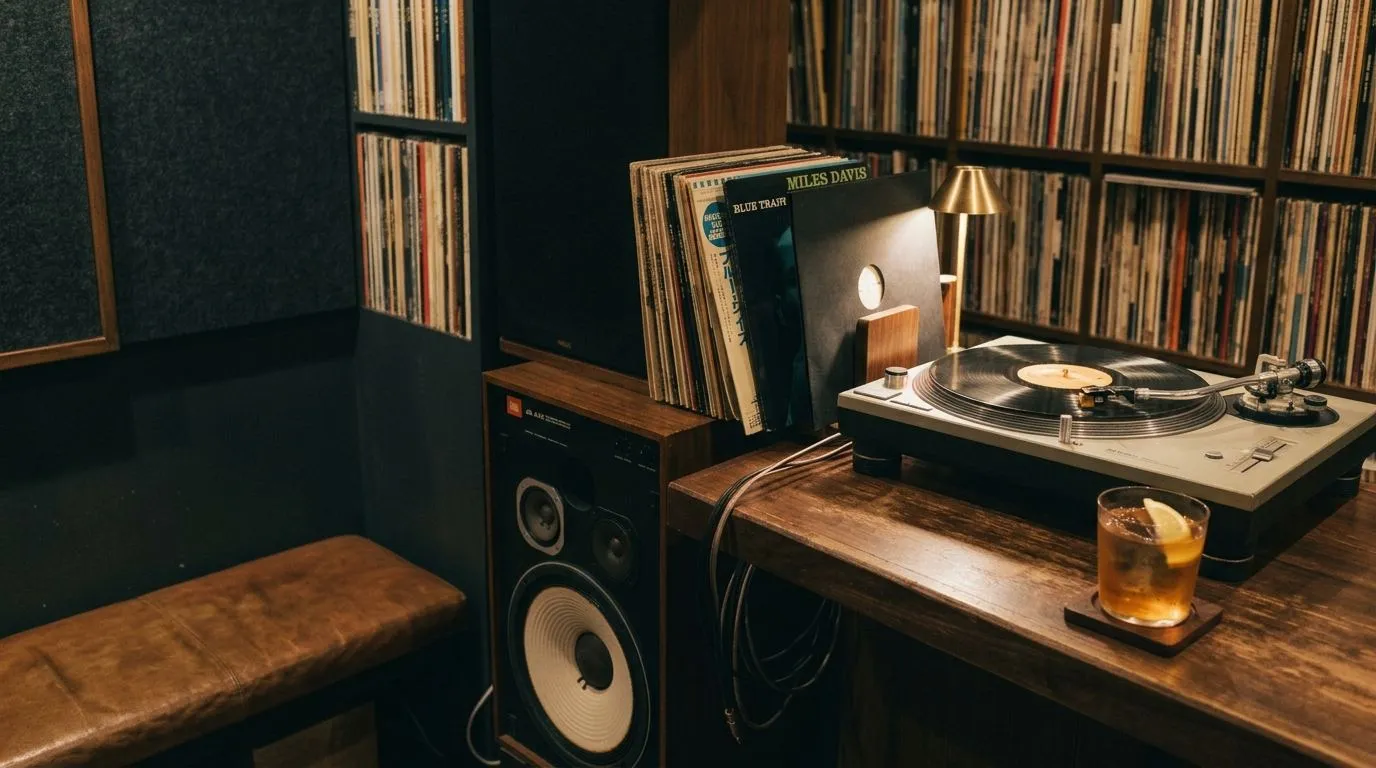
Two music bars opened in the same week in Tokyo. RED RECORDS, in an Akasaka building: analog vinyl, vintage furniture, classic cocktails, a room built to listen to a whole record. Omusubi Jazz Club, in a back alley of Araki-cho in Yotsuya: a French chef in the kitchen, professional musicians on stage, onigiri and jazz for a small crowd. Two openings in seven days is not a coincidence.
A global phenomenon that started in Tokyo
The listening bar has become a category of its own in nightlife worldwide. Bars you go to for the sound as much as for the drink: a high-end hi-fi system, vinyl, low light, near-religious listening. Observer documented their rise from Tokyo to New York in April 2026, The Spirits Business explained in March how operators around the world took Japanese bars as their model, and Roadbook describes cities covering the Japanese listening bar the way you cover a song.
The speed is the striking part. Three years ago the format was a niche for jazz and hi-fi enthusiasts. In 2026, Live Nation, the largest concert promoter in the world, opened a Vinyl Room in Hollywood. The phenomenon has left the audiophile circles.
And Tokyo is still the reference. listenbars.com, a worldwide directory of listening bars, gives a full page to the Tokyo Music Bar in Mexico City, a cocktail bar built on the Japanese model. When a bar in Mexico City names itself after a Tokyo reference, the blueprint is here.
The jazz kissa heritage
Tokyo did not invent the listening bar by accident. The city has a seventy-year tradition: the jazz kissa, born in the 1950s, a café where you come to listen to jazz on a serious system, in silence, with no obligation to talk. Condé Nast Traveler recently noted that the best jazz kissaten in Tokyo are still running, some since 1967. The Guardian devoted a photo series to them: stacks of whisky, vinyl and absurdly expensive speakers.
The jazz kissa established three things the modern music bar still lives on.
- Listening is an activity: the record is not background noise, it is what you came for.
- Equipment is an argument: speakers get named, quoted, and sometimes follow their owner from one room to the next.
- Silence and atmosphere are paid for: that is what justifies a higher ticket than the izakaya across the street.
The 2020s music bar adds two bricks the jazz kissa never had: the serious cocktail and food. That is where the difference is made.
Why now: five forces aligned
A format does not come back on its own. This one benefits from five movements that fell into phase.
- The vinyl comeback: in the United States, vinyl sales have passed CDs for several years, and growth holds, carried by a generation that did not live through records the first time (RIAA). A vinyl bar therefore leans on a culture that grows outside its own walls.
- The third place crisis: sociologist Ray Oldenburg coined the term in 1989, the place that is neither home nor work, where you know the regulars and can linger without spending heavily. The Congress for the New Urbanism wrote in January 2025 that these places have never been more useful against isolation. In Japan, where loneliness is a public health issue, the demand is stronger still. A music bar is an almost perfect third place: you come alone, you stay without having to talk, and you are not alone.
- The experience economy: Japanese consumption has shifted toward what you live rather than what you buy. Concept bars, dinner-show restaurants and immersive cafés multiply for that reason. The music bar ticks the boxes: a strong identity, a reason to go beyond the drink, a story to tell.
- The return to physical places: since reopening, the formats that offer what a screen cannot, presence, real sound, contact, have been gaining ground again.
- The Japanese context: young Tokyoites go out less than before but go out better, and loud mega-izakayas are losing ground to rooms with a point of view. Meanwhile inbound tourism breaks records and looks for addresses that feel local without being touristy.
The Tokyo landscape in 2026
The movement has been visible for two years. In spring 2026, PASS opened in Shibuya, run by the team behind techno bar VENT, with a custom JBL system and a listening seat placed at the sweet spot. Hi-Fi Disco Bar Chaos followed, all vinyl, 1970s New York mood, JBL 4350 speakers. Kuro-Tokage opened in Aoyama within the RED BAR family, with Klipsch La Scala speakers sourced from Lighthouse Records. Kompakt Record Bar, the Korean brand's first room outside Seoul, opened in Ikejiri in May. Spincoaster Music Bar, run by the media company of the same name, landed in Kagurazaka in December 2025. SON Records & Ambient Cafe had opened as early as February 2025 in Shibuya, with Korean food and vintage TANNOY speakers.
The pattern fits in one sentence: almost all of these are pure bars. PASS has no kitchen, neither does Chaos, nor Kuro-Tokage, nor Kompakt. The full trio, music, concept and real food, stays rare. The exceptions are the most interesting ones.
- SON Records & Ambient Cafe: Korean food, in a café format.
- THE MUSIC BAR CAVE: moved from Yoyogi Village, a real bistro menu and 3,000 records.
- OFF RECORD: on the 43rd floor of the Fairmont Tokyo, light bites only.
- Omusubi Jazz Club: onigiri and French bistro cooking, with jazz played live.
- RED RECORDS: signature cocktail pairings during the opening week.
That is the space left open. Most operators bet on music alone, very few add food. And food is what turns a bar from a night out into a place people live in.
The business model
A Tokyo music bar lives on three revenue streams, and none of them is enough on its own.
- The bar: cocktails, wine, spirits. This is the healthiest margin and the core of the model. A 1,800 yen cocktail leaves 70 to 80% once the cost of goods is out.
- Food: snacks, boards, plates. It raises the average ticket, extends dwell time, and opens the door to a lunch service or a happy hour.
- Events: DJ sets, intimate concerts, themed nights, curated listening sessions. This is what creates the appointment, the reason to come back, and sometimes a cover charge.
An order of magnitude, to be taken for what it is. A twenty-seat room, 70% full in the evening, with an average ticket mixing cocktails and boards.
| Line | Amount |
|---|---|
| Average ticket, cocktails and boards | 5,000 yen |
| Takings for one evening service | 70,000 yen |
| Monthly revenue depending on opening days | 1.5 to 2 million yen |
| Rent for a small neighbourhood space | 300,000 to 600,000 yen |
The model holds on two conditions: that the drink margin is real, and that food is not sold at a loss. The classic trap is to count on the bar and the regulars, and to program nothing.
A music bar that programs nothing dies slowly.
The format that works is the one with a calendar, an identity and a reason to come back.
Our read
We work with founders who want to open in Tokyo, and several describe the same thing: a room where music structures space and time, with real food. Here is what this analysis tells us.
- The window is open, and the full trio makes the difference: most recent openings are pure bars. A room that holds music, concept and cooking at once stands on almost empty ground.
- Food is the real subject: customers come for the atmosphere, they come back for the plate. It also changes the economics, the ticket rises and lunch service becomes possible.
- Music selection is an identity, not decor: the rooms that work have a point of view, jazz, disco, ambient, rare vinyl. Equipment is an argument, identity builds the community.
- The room needs a calendar: events are what bring people back. A bar without programming fades out.
- Real estate is the referee: these formats work in high-flow neighbourhoods, Shibuya, Aoyama, Ginza, and also in streets with history like Araki-cho. The space is often small, and that is a strength: intimacy is part of the concept.
Choosing the neighbourhood, costing the space and holding the calendar through to opening is the work we do with a founder.Opening in Japan
Sources
- Observer, the rise of listening bars from Tokyo to New York, April 2026
- The Spirits Business, Hear to stay, behind the rise of listening bars, March 2026
- Roadbook, listening bar culture and how we gather, July 2026
- myvinyls.app, The Rise of Listening Bars, March 2026
- listenbars.com, worldwide database of listening bars
- Wikipedia, Jazz kissa
- Condé Nast Traveler, Tokyo's jazz kissaten are still the best in the world
- The Guardian, One kissa is all it takes, Tokyo's finest jazz haunts in pictures, October 2023
- Congress for the New Urbanism, fighting loneliness with parks and third places, January 2025
- klangheimat.de, why records are booming again in 2025 and 2026
- Ray Oldenburg, The Great Good Place, 1989
- RIAA, annual reports on recorded music sales
Frequently asked questions
Is a music bar profitable in Tokyo?
Yes, if the model is balanced between bar, food and events. A pure bar living on cocktails alone has a low ceiling and depends entirely on its regulars.
Do you need a large hi-fi budget to open?
Equipment matters, but musical identity and programming matter more. You can start with a good system and upgrade it once the room is full.
Is silence mandatory in a music bar?
No. The jazz kissa enforces silence, the modern music bar is looser. The best rooms handle both, serious listening and conversation, often by separating the moments of the evening.
Which neighbourhood should you choose in Tokyo?
A high-flow area with nightlife, Shibuya, Aoyama, Ginza, Yotsuya, or a street with history. Rent has to stay consistent with the average ticket you aim for, between 300,000 and 600,000 yen for a small space.
Can you open without bar experience?
Technique can be delegated, music selection and the calendar cannot. You have to love it, because that is exactly what brings customers back.

The letter
土台 Journal, every week.
The restaurants and shops that have just opened in Tokyo, found on foot. Past issues are readable in full, with no sign-up.
Read next
Analysis
Tokyo's burger market passes one trillion yen
A record market, funds bidding for the chains, and burgers sold at steak prices. What a foreign brand needs to know before entering Tokyo.
Analysis
Customer experience is not a spectacle
42.7 million visitors and a shift toward experiences, with a misreading in the middle. What brings a customer back, and what does not.
Analysis
Why 30% of Tokyo Restaurants Close Within a Year, and How to Avoid It
Bankruptcies in Japanese food service are at record highs. Behind the figure, five causes that turn up in almost every file we audit.
A guide informs. A project needs a closer look.
Let's look at yours.
Book a 30-min callA costing rather than a conversation? Request a quote