Practical guide · Pop-up
Pop-Up Store in Tokyo: The Complete 2026 Guide
From a gallery rented for a weekend to a department store stand: the pop-up formats in Tokyo, the venues and their rates, what you can settle without a Japanese company, and the timeline to plan.
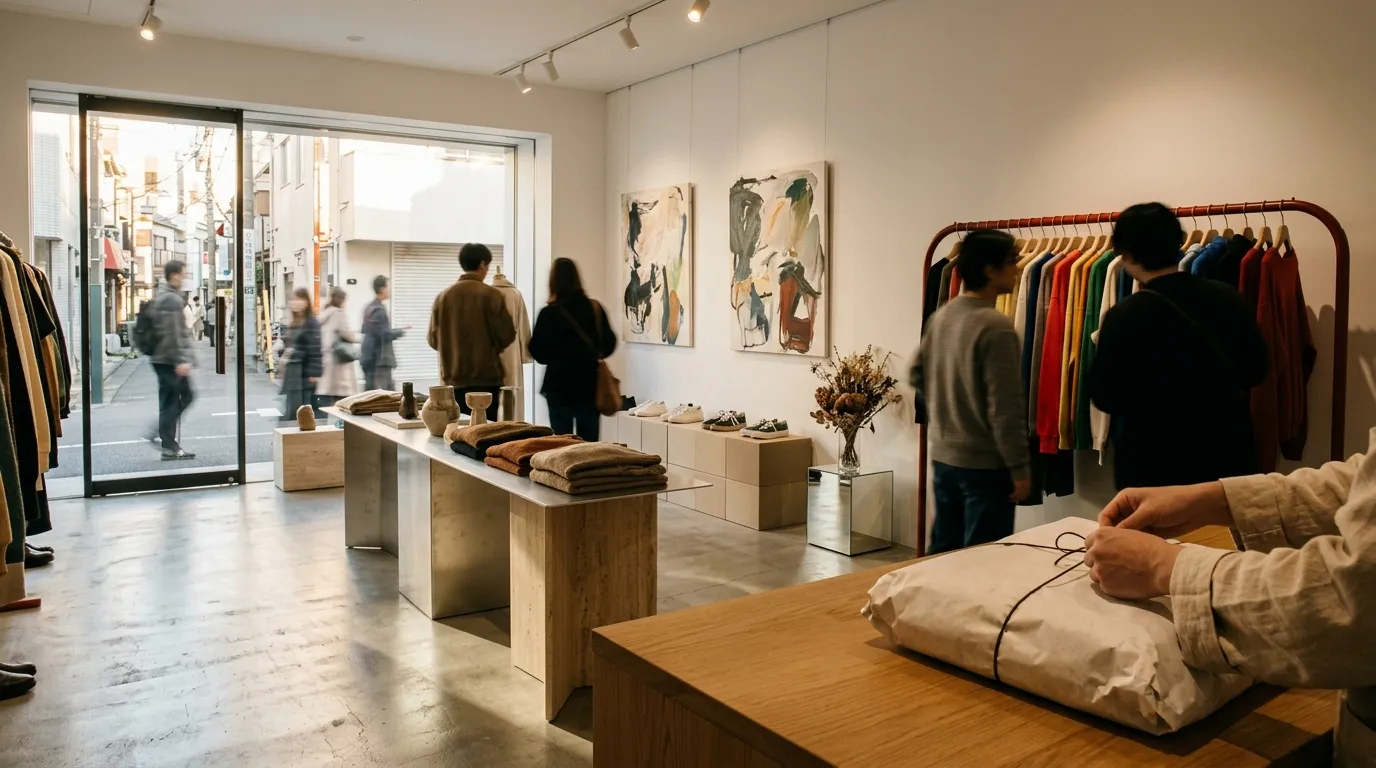
On October 11 and 12, 2026, New York label Merci Dema opens its first pop-up in Tokyo. Its founder, Melly, a former lawyer from Milwaukee, took a ground floor in Sendagaya, a few minutes from Harajuku, for two days. He is showing his second collection, Borough Appreciation, alongside work by Tokyo artist Daichi Minato and a burger stand, Pon Pon Burger. He is there both days.
Key takeaways
A pop-up store is a sales space open for a few days or weeks, without a commercial lease. A foreign brand can open one in Tokyo without setting up a Japanese company: a local company can run the operation for it, or it can sell in its own name with a tax representative. Rent runs from a few thousand yen a day for a small spot to more than two million for the large event spaces.
- Choose the format before the venue: a rented pop-up shop, a shopping centre pop-up space, a large event space or a department store stand. Each has its own prices, lead times and way of selling.
- Prices cover every budget: under ¥50,000 a day for a small gallery or a room in Ginza, ¥100,000 to ¥500,000 in Shibuya's complexes, ¥1 to 2.5 million for Space O at Omotesando Hills or Roppongi Hills Arena.
- To sell in its own name, a foreign company with no office in Japan must declare a tax representative. A Japanese company can also run the operation: it rents, takes payments and hires for the brand.
Choose the format before the venue
Four pop-up formats exist side by side in Tokyo, and they are not rented or sold the same way. Choosing early saves you from looking for a venue that will not fit.
- The rented pop-up shop. A gallery or street-level space rented by the day or week, which the brand fits out in its own image. This is Merci Dema's format in Sendagaya. The most sought-after galleries go early: near Meiji-jingumae station, a glass-fronted ground-floor gallery is fully booked for all of 2026. It is the format that gives the most freedom over the set, the prices and the relationship with customers.
- The shopping centre pop-up space. Shibuya and Harajuku centres rent dedicated spots, in the middle of a crowd that is already there. SHIBUYA109 takes fashion, accessories, cosmetics and food, mostly sweets, and in late 2024 launched a programme of Korean brand pop-ups on its 4th floor, with RONRON and then hype2k, both firsts in Japan. MIYASHITA PARK rents spots of 6 to 56 m² by the week. In stations, LUMINE offers small spots in Shinjuku with no fixed rent, paid through a commission on sales.
- The large event space. Space O at Omotesando Hills, the Tokyo Midtown Atrium, Roppongi Hills Arena or the KITTE Marunouchi Atrium host collection launches and large brand operations. They are Tokyo's most expensive venues, with technical costs on top.
- The department store stand. Department stores run their own sales, on their own calendar, and choose the brands. Isetan Shinjuku brought together 153 brands at its Salon du Chocolat in January and February 2026, a record according to the group, and more than 100 at its British fair in March, the 11th, which sells about 10,000 scones a day. Here the brand sells as one of the store's suppliers: it does not rent a space, it has to be selected.
| Format | How it is rented | For whom | Example |
|---|---|---|---|
| Rented pop-up shop | by the day or week | a brand that wants its own set and to meet its customers | Merci Dema, Sendagaya, 2 days |
| Shopping centre space | application to the centre, rent or commission | a brand looking for a targeted footfall | SHIBUYA109, MIYASHITA PARK, LUMINE |
| Large event space | daily rental, technical costs on top | a collection launch or a brand operation | Space O, Tokyo Midtown, Roppongi Hills |
| Department store stand | selected by the store, supplier contract | a food, gift or fashion brand picked by the buyer | Isetan's Salon du Chocolat and British fair |
A pop-up does not need to lead to a shop. In a late-2024 survey of 410 Japanese marketers, brands cited awareness first (52.1%), then sales (39.8%) and new customers (35.1%). A brand can run one with each collection.
Sources: Merci Dema press release (October 2026), SHIBUYA109, MIYASHITA PARK, LUMINE, Mitsukoshi Isetan, COUNTERWORKS 2024 survey.
The real budget
A pop-up in Tokyo can cost under ¥50,000 a day or more than two million. Rent depends first on the neighbourhood, then on the type of venue, and only then on floor area.
On rental platforms such as SHOPCOUNTER, instabase or Location Hunting, spots start at a few thousand yen a day. For a street shop, SHOPCOUNTER publishes three bands: ¥3,000 to ¥7,000 in the suburbs, ¥15,000 to ¥30,000 near major stations and on shopping streets, ¥40,000 to ¥200,000 in Omotesando, Shibuya or Daikanyama. In Omotesando, small glass-fronted galleries rent from ¥38,500 a day, and in Ginza 1-chome, a 50 m² room that converts into a pop-up costs ¥26,840 a day.
| Price band (per day) | What you find | Examples |
|---|---|---|
| Under ¥100,000 | small galleries, convertible rooms, spots in shopping centres or near stations | 26 m² glass-fronted gallery in Omotesando from ¥38,500; 50 m² room in Ginza 1-chome, ¥26,840; shopping streets near stations, ¥15,000 to ¥30,000 |
| ¥100,000 to ¥500,000 | street shops in sought-after districts, spots inside the complexes | ground floors in Omotesando, Shibuya or Daikanyama, up to ¥200,000; small MIYASHITA PARK spot, ¥150,000 on weekdays; Shibuya Hikarie 8/ COURT, ¥400,000; Daikanyama T-SITE Garden Gallery, ¥450,000 |
| ¥500,000 to ¥1,000,000 | architect galleries, large covered plazas | Tadao Ando gallery in Jingumae, ¥605,000 to ¥715,000; Roppongi Hills Oyane Plaza, ¥800,000 on weekdays |
| Over ¥1,000,000 | large event spaces | Space O at Omotesando Hills, ¥1,000,000 to ¥1,200,000; KITTE Marunouchi Atrium, ¥1,200,000; Tokyo Midtown Atrium, ¥1,100,000 to ¥1,650,000; Roppongi Hills Arena, ¥2,000,000 to ¥2,500,000 |
Some venues rent by the week: MIYASHITA PARK's atrium plaza, about 56 m², costs ¥3 million a week. Others publish no rates, such as Harakado, GINZA SIX, GYRE or department stores for their stands. And in stations, LUMINE replaces rent with a commission on sales, with no guaranteed minimum: the cheapest way in, on very small spaces.
The rest of the budget often weighs as much as the rent, especially in large venues. A full pop-up quote covers:
- Technical costs and security. At Roppongi Hills Arena, the sound kit is ¥450,000 and the lighting kit ¥300,000 a day; MIYASHITA PARK charges ¥250,000 a week for security.
- Set-up and take-down. In large venues, set-up days are paid, often at around half the opening-day rate.
- Fit-out. Furniture, displays, signage, extra lighting, made or rented locally.
- The sales team. Staff hired for the run, Japanese-speaking, briefed on the brand.
- Communication. Press, social media and local partners, to bring in more than passers-by.
- Stock and logistics. Shipping, duties, storage during the run.
That is why we cost every pop-up line by line before a brand commits: duration, venue and format move the total far more than floor area.
Sources: SHOPCOUNTER, instabase and Location Hunting listings (October 2026); published rate cards of Mori Building, Omotesando Hills, Tokyo Midtown, KITTE, MIYASHITA PARK, Shibuya Hikarie, Daikanyama T-SITE and LUMINE. Amounts before tax, except Location Hunting (tax included).
Who runs the sale
To sell in Japan, someone has to rent the venue, take payments and invoice with consumption tax. A foreign brand has two routes.
- A Japanese company runs the operation. It signs with the venue, takes the sales, hires the team and handles invoicing; the brand brings its products and its image, without setting up a company for a few days or weeks. This is what Dodai Studio does for brands, depending on the format and the venue.
- The brand sells in its own name. It then owes consumption tax (shohizei) once it crosses the thresholds, and appoints a tax representative (nozei kanrinin).
- The standard rate is 10%, with a reduced 8% for food other than alcohol.
- A business is in principle exempt if its taxable sales in Japan during the base period do not exceed ¥10 million. Since October 1, 2024, a foreign company with capital of ¥10 million or more that starts selling in Japan is taxable from the start, and a business without a permanent establishment in Japan can no longer use the simplified scheme.
- For its business customers to recover the tax, it issues qualified invoices (tekikaku seikyusho), a system in place since October 1, 2023. The tax authority refuses registration to a company with no office in Japan that has not declared its tax representative.
- The department store case. At a department store stand, the brand sells as a supplier. Japanese competition rules name three ways a large retailer sources goods: outright purchase (kaitori shiire), consignment (itaku shiire) and shoka shiire (消化仕入れ), where the store only buys the goods at the moment a customer pays. A large retailer can send back unsold stock in four cases only: a fault by the supplier, terms agreed in advance, the supplier's consent with compensation for its loss, or the supplier's own request. Department store commission rates are not public: check in the contract who collects the money, when the store pays you, who carries unsold stock and who provides the sales staff.
Sources: National Tax Agency, Japan Fair Trade Commission.
The products: customs, labels, food
The first question is simple: are your products already sold in Japan? If they are, a local distributor or importer can supply the stock. If not, they have to be imported, and importing is a trade of its own, with its own rules.
- Customs. A brand that imports its own stock without being resident in Japan appoints a customs representative (zeikan jimu kanrinin) and declares them to Japan Customs in advance; the same form (C-7500) can declare the tax representative. Since October 1, 2023, the name and address of the importer are a required entry on the declaration. Duties depend on each product's tariff code.
- The ATA carnet. It lets you bring in commercial samples, professional equipment and display items temporarily and duty-free, for one year at most, as long as they leave Japan before it expires.
- Labelling. An imported food product shows the country of origin and the importer's name and address, on top of the usual entries: product name, ingredients, additives, quantity, best-before date and storage.
- Food and drink. In Tokyo, the short-term temporary permit (tanki kotei-gata rinji eigyo) is for a one-off event open to the public, such as a neighbourhood festival or a sports event, and explicitly excludes promotional sales held day after day in supermarkets or department stores. Since June 1, 2021, selling packaged products that keep at room temperature without a hygiene risk is exempt from notification. For alcohol, some venues already hold the permits and others do not: it is one of the first things we check.
Sources: Japan Customs, Consumer Affairs Agency, Tokyo Metropolitan public health bureau, Ministry of Health.
The venue takes the longest
The venue is almost always what takes the longest in a pop-up, and the most sought-after ones book months ahead. Omotesando Hills takes options on Space O up to six months before the date. SHIBUYA109 answers a request within two or three working days, then counts one to three months of preparation before opening.
Choose the neighbourhood by the crowd you want. Harajuku and Omotesando concentrate Tokyo's pop-ups: they hosted 38% and 29% of them in 2015, and more than half of the pop-ups counted lasted under two weeks. Ginza and Marunouchi speak to a wealthier clientele and office workers, Shibuya and Shinjuku to station footfall, Sendagaya or Daikanyama to customers who come for the brand.
One piece of advice that costs nothing: go and see the venue on a Saturday and on a Tuesday. A pop-up lives on the footfall of the days it opens.
Sources: Omotesando Hills, SHIBUYA109, CBRE count covered by Ryutsu News (2019).
On the day
A pop-up plays out on site: the team, payments, welcoming foreign customers.
- The team. Staff hired for the run, briefed on the brand and its products, who speak Japanese and, depending on the neighbourhood, English or Chinese. A founder in the room, like Melly at Merci Dema, changes the relationship with the first customers.
- Payments. In 2025, 58.0% of payments in Japan were cashless, 82.7% of them by credit card and 10.2% by QR code. A pop-up takes cards and the main QR codes from day one.
- Foreign customers. Japan welcomed 42,683,600 foreign visitors in 2025, a record, who spent ¥229,000 each on average. Tax-free sales move to a refund system on November 1, 2026: the approved shop charges the tax, the visitor has the goods checked by customs on departure within 90 days, then gets the refund.
Sources: METI, JNTO, Japan Tourism Agency, National Tax Agency.
The timeline, backwards
On the pop-ups we prepare, allow four to six weeks once the format is decided; what stretches the timeline is the venue's availability.
| When | What |
|---|---|
| Up to 6 months ahead | put an option on the most sought-after venues (Space O, Omotesando galleries) |
| 1 to 3 months ahead | application to a shopping centre (SHIBUYA109); decide who runs the sale; start importing if the products are not in Japan |
| 4 to 6 weeks ahead | fit-out, team, communication, permits |
| On the day | set-up, opening, payments, take-down |
Season matters too. December is the strongest month for Japanese department stores, August the weakest: ¥654.2 billion in sales in December 2025 against ¥413.9 billion in August, driven in December by New Year food, Christmas cakes and year-end gatherings.
Source: Japan Department Stores Association.
Five things to settle early
- The venue. It sets the date: book it before you plan the rest.
- Who takes the money. A Japanese company running the operation, or your declared tax representative: decide before you sign with the venue.
- The stock. Already available in Japan, or to be imported through an importer: importing takes time and has its own rules.
- The full budget. Technical costs, security, set-up, staff and communication come on top of the rent.
- Permits. Some venues, formats and drinks need permits you will not get in three weeks.
Sources
- BAOBAB, Merci Dema press release on its first Tokyo pop-up, PR Times, October 4, 2026
- Mitsukoshi Isetan Holdings, Salon du Chocolat 2026 and British Fair 2026, PR Times
- SHIBUYA109 Entertainment, terms for opening a pop-up
- COUNTERWORKS, 2024 survey on pop-up stores, PR Times, November 20, 2024
- SHOPCOUNTER MAGAZINE, what a pop-up store costs, June 17, 2026
- Location Hunting and instabase, listings in Omotesando and Ginza, accessed October 9, 2026
- Mori Building, Roppongi Hills Arena, Ōyane Plaza and Azabudai Hills Arena sheets, 2026
- Omotesando Hills (Space O), Tokyo Midtown and KITTE, event space rate cards
- MIYASHITA PARK, Shibuya Hikarie 8/, Daikanyama T-SITE and LUMINE, space rates
- Japan Fair Trade Commission, guidelines on large-scale retailers' transactions
- National Tax Agency: consumption tax, exemption threshold, qualified invoices, tax-free sales
- Japan Customs: customs representative and ATA carnet
- Tokyo Metropolitan Government, temporary permit; Ministry of Health; Consumer Affairs Agency, labelling
- CBRE, pop-ups in Tokyo, covered by Ryutsu News, July 2019
- METI, cashless payments 2025; JNTO and Japan Tourism Agency, visitors and spending 2025
- Japan Department Stores Association, 2025 sales
Amounts exclude tax unless stated.
Frequently asked questions
Do I need a Japanese company to open a pop-up store in Japan?
No. A Japanese company can run the operation for the brand: it rents the venue, takes payments and hires. The brand can also sell in its own name, provided it declares a tax representative to invoice with consumption tax, and a customs representative if it imports itself.
How much does a pop-up store in Tokyo cost?
Rent runs from a few thousand yen a day for a small spot to more than two million for the large spaces: under ¥50,000 for a small gallery in Omotesando or a room in Ginza, ¥100,000 to ¥500,000 in Shibuya's complexes, ¥1 to 2.5 million for Space O or Roppongi Hills Arena. Technical costs, security, set-up, staff and communication come on top.
How long does it take to prepare a pop-up in Tokyo?
Allow four to six weeks once the format is decided, longer if the venue you want is in demand: Omotesando Hills takes options up to six months ahead, and SHIBUYA109 counts one to three months of preparation.
Which Tokyo neighbourhood for a pop-up?
Harajuku and Omotesando host the most pop-ups. Ginza and Marunouchi target a wealthier clientele, Shibuya and Shinjuku station footfall, Sendagaya or Daikanyama customers who come for the brand.
Do I have to open a shop after a pop-up?
No. A pop-up is an event in its own right, often a few days long, and brands cite awareness first as the effect they are after. A brand can run one with each collection.
Can I sell food or alcohol at a pop-up in Tokyo?
Yes, depending on the venue. Packaged products that keep at room temperature have been exempt from notification since June 1, 2021. Tokyo's temporary permit excludes promotional sales in department stores, and for alcohol, some venues already hold the permits and others do not.

The letter
土台 Journal, every week.
The restaurants and shops that have just opened in Tokyo, found on foot. Past issues are readable in full, with no sign-up.
Read next
Practical guide
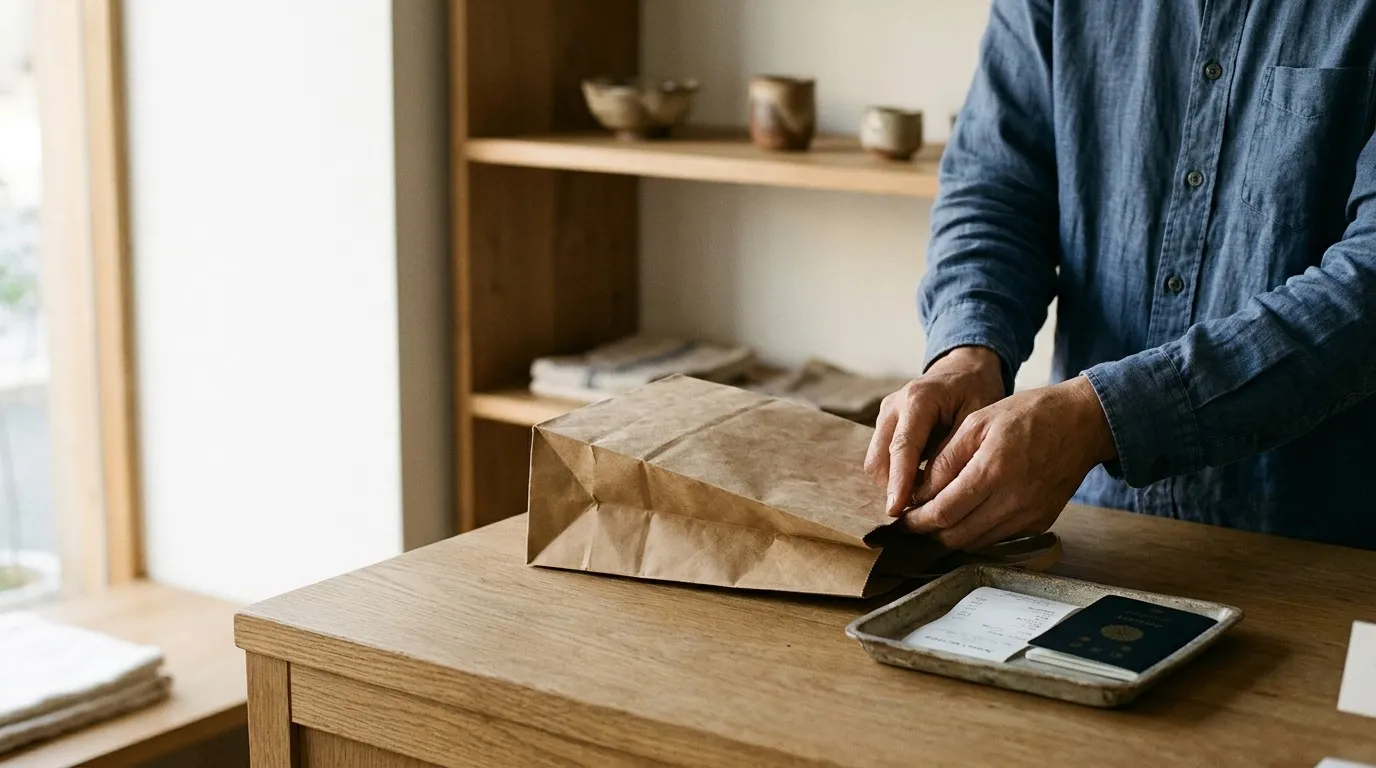
Japan's tax-free shopping changes on 1 November 2026: what retailers need to know
On 1 November 2026, Japan switches to a refund system for tax-free shopping. Tourists pay the tax at the till and get it back once customs has checked their purchases. A shop, a department store or a foreign brand that sells to visitors will have to change how it prices, refunds and reports each sale.
Practical guide
Your head office is abroad: the five ways to open in Japan
Subsidiary, branch, representative office, master franchise, joint venture. What each form changes for the lease, the licences and the money.
Practical guide
How to open a coffee shop in Japan: the complete 2026 guide
From takeaway kiosk to roastery café: the formats, the real costs, the licences, the equipment and the traps specific to the Japanese market.
A guide informs. A project needs a closer look.
Let's look at yours.
Book a 30-min callA costing rather than a conversation? Request a quote