Practical guide · Coffee
How to open a coffee shop in Japan: the complete 2026 guide
From takeaway kiosk to roastery café: the formats, the real costs, the licences, the equipment and the traps specific to the Japanese market.
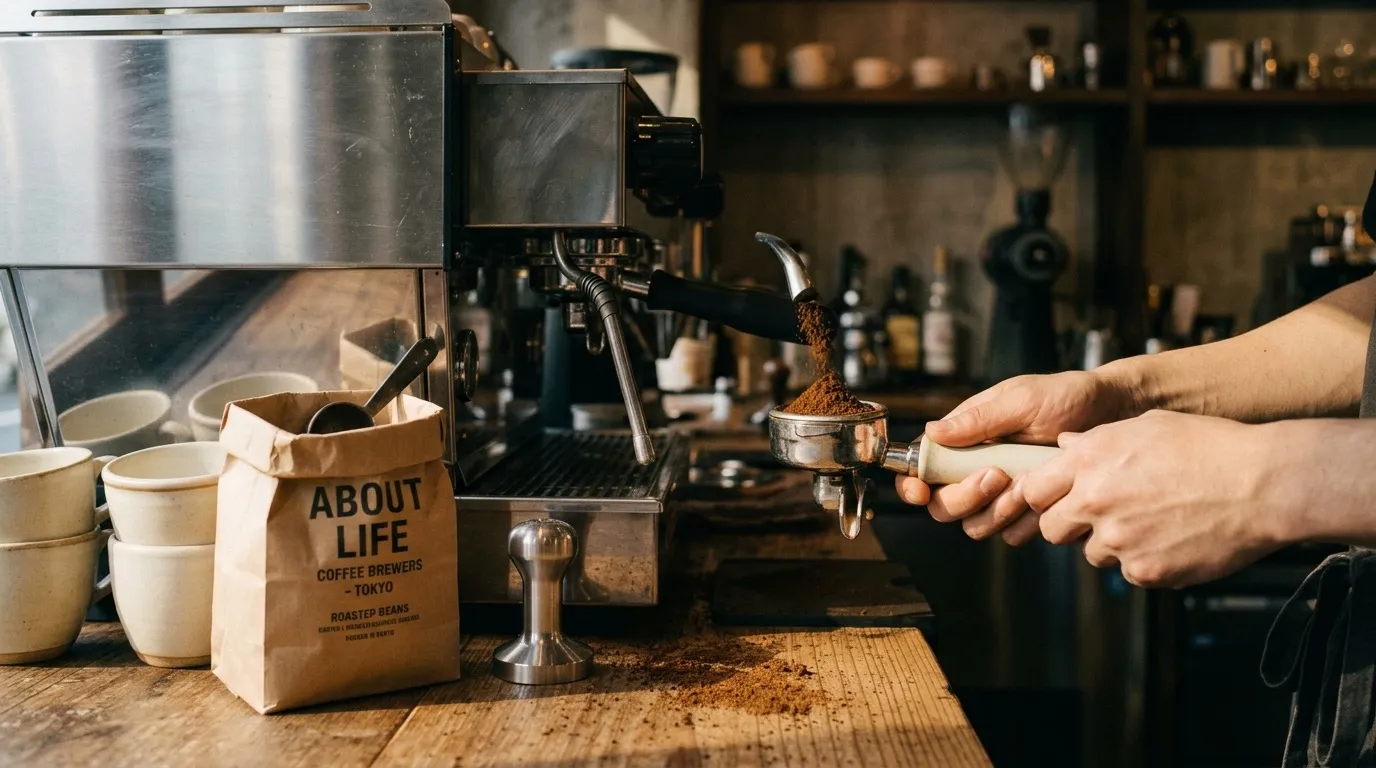
Coffee is the most accessible doorway into the Japanese hospitality market. Less staff than a restaurant, fewer kitchen constraints, a rising average ticket. But coffee in Japan does not mean one thing, and the first decision is not the decoration: it is the format.
Choose the format before anything else
Four formats coexist, and they share neither budget, model nor clientele. Choosing early avoids hunting for a location that will not fit.
- The takeaway kiosk: a few square metres, a counter, little or no seating. This is the BE A GOOD NEIGHBOR model, opened in 2010 in a Sendagaya kiosk. Less rent and less staff, but a lower ticket and total dependence on foot traffic.
- The specialised coffee stand: few seats, a very short menu, a strong position. KOFFEE MAMEYA started this way in 2011 before opening its Kakeru address ten years later. The stand lets you test a concept on a contained investment.
- The sit-down café: a room, a machine, a small food offer. Bigger, more fitted out, more floor staff. The most common format, and the most demanding on cash.
- The café with in-house roasting: the most expensive and the most differentiating. A roaster, a production space, dedicated ventilation. Blue Bottle built its Japanese legend on this model, starting from eight seats in Kiyosumi-Shirakawa.
The rule holds across the sector in Japan: start compact, prove the concept, then grow. An oversized first venue is the fastest way to burn through cash before finding your customers.
The real budget, format by format
The ranges you find online vary wildly because they mix formats. Here are the all-in orders of magnitude, including lease deposits, fit-out, equipment, legal structure, opening stock and working capital.
| Format | All-in budget |
|---|---|
| Takeaway kiosk | ¥15M to ¥25M |
| Specialised coffee stand | ¥18M to ¥28M |
| Sit-down café, 30 to 50 m² | ¥25M to ¥40M |
| Café with in-house roasting | ¥40M and above |
The item that surprises most remains the lease. As for a restaurant, shikikin and reikin commonly amount to six to ten months of rent paid upfront. The floor area is smaller than a restaurant, the principle is identical.
Anyone quoting a precise figure without having seen a shortlist of locations is not calculating, they are guessing.
Licences, and the order to handle them in
A café selling drinks, and possibly food, falls under the restaurant regime. Three points structure the timeline.
- The operating licence: the 飲食店営業許可, issued by the public health centre for a specific location. The application includes an on-site inspection.
- The food sanitation manager: the 食品衛生責任者 is mandatory for the location. The training is short and accessible.
- The prior consultation: visit the health centre before signing the lease. They check water, ventilation and equipment, and spare you discovering a refusal after signature.
The licence is attached to the location. Changing address means redoing the entire procedure. One more reason to validate a location carefully, and never to sign before consulting.
The neighbourhood, which is not a logistics detail
The choice of neighbourhood is a statement, and the criteria change completely with the format you picked.
- For a kiosk: foot traffic beats everything. Station surroundings, office zones, tourist districts. Rent is higher, but the model depends on it entirely.
- For a sit-down café: a mix of flow and quality of life. Sangenjaya, Kichijoji, Shimokitazawa or the quiet streets of Omotesando draw a clientele that settles in.
- For a roastery: the neighbourhood is part of the brand story. Kiyosumi, Kuramae or Koenji allow a strong position at more accessible rents.
One piece of advice that costs nothing: spend time on site before deciding. A café lives on its neighbourhood regulars, not on passing tourists. Watch who settles, who returns, and what is missing.
Equipment: buy, rent, or share
Coffee equipment is the item specific to this project, and underestimating it is common. Three approaches exist, and they are not exclusive.
- Buy: the simplest, the heaviest on cash at the start. A professional espresso machine is an asset that lasts, provided it is maintained.
- Rent: many Japanese suppliers offer rental with maintenance included. It is the most common choice at launch, precisely to protect cash flow.
- Share: the Shibuya Roasting Collective, founded in 2020, brings together fourteen independent roasters sharing space, equipment and quality control data. A real option for roasting without buying your own roaster.
For beans, two routes: buy roasted from a local roaster, the simplest way to start, or import green and roast yourself, more differentiating but considerably heavier. Many Japanese cafés do both.
Matcha, the extension that is no longer debated
A café opening in Japan in 2026 should look closely at matcha. The domestic market has moved from about 20 billion yen in 2018 to an estimated 30 to 40 billion today, driven by matcha latte, desserts and tourist demand. Global demand exceeds supply.
The matcha latte is already a coffee product: ordered at the same counter, with the same gesture, and it speaks at once to the local customer and to the global trend. In a market where concepts look alike, it is an inexpensive difference to install.
The five mistakes that kill a café in Tokyo
What we see fail most often, in order of frequency.
- Underestimating the budget: lease deposits, equipment and starting cash add up and surprise everyone. An undercapitalised café does not last six months.
- Copying a concept without reading the neighbourhood: what works in Omotesando does not necessarily work in Kichijoji.
- Neglecting the licence: signing a lease without consulting the health centre can delay opening by months.
- Ignoring matcha: sticking to espresso alone leaves aside the strongest trend of the moment.
- Carrying it all alone: without a local team, a foreign project burns out in months. An experienced barista is not an option, it is the key role.
Count six to twelve months for a simple format, more with roasting or heavy fit-out. It is the health centre consultation and the licence that structure the timeline, not the building work.
A word on the timeline, because the published ranges mix two periods that have nothing to do with each other. On the projects we support, a complete file takes six to twelve months. What decides the length is neither the building work nor the licences: it is the time needed to find the right premises.
Once the lease is signed, the target is three months to opening, building work included.
The rule comes from simple arithmetic: from signature onwards, every month of rent paid without trading is a straight loss. Our job is therefore to prepare everything during the search, so that signing triggers execution rather than a start. A file that is ready on the day of the lease is worth several months of cash.
Sources
- Expert Market Research, marché japonais du café, 2025 à 2035
- worldmetrics, consommation de café par habitant au Japon
- Smart Start Japan, inspection du centre de santé et installation retail
- KOFFEE MAMEYA, du coffee stand de 2011 à l'adresse Kakeru
- BE A GOOD NEIGHBOR, le kiosque de Sendagaya ouvert en 2010
- Bean Brew Digest, le Shibuya Roasting Collective et ses 14 torréfacteurs
- Aplash, frais d'immatriculation d'une KK et d'une GK
- matcha-times, marché intérieur du matcha, enquête ministère de l'Agriculture
Frequently asked questions
Do I need a special licence for a café in Japan?
A café falls under the restaurant operating licence, the 飲食店営業許可, issued by the local health centre for a specific location, with a designated food sanitation manager. The licence is attached to the premises.
How much does opening a café in Tokyo cost?
A compact kiosk or coffee stand: roughly 15 to 25 million yen all in. A 30 to 50 m² sit-down café: 25 to 40 million. Lease deposits often amount to six to ten months of rent.
Can I open a café without roasting?
Yes, most cafés buy their beans from local roasters. In-house roasting is a differentiating option, more expensive, requiring skill, space and dedicated ventilation.
Is matcha essential in a café in Japan?
Not essential, but strongly recommended. It is the strongest trend of the moment, and the matcha latte is ordered at the same counter as espresso, without changing how service is organised.
How long does it take to open?
Count six to twelve months for a simple format, more with roasting or heavy fit-out. It is the health centre consultation and the licence that structure the timeline, not the building work.

The letter
土台 Journal, every week.
The restaurants and shops that have just opened in Tokyo, found on foot. Past issues are readable in full, with no sign-up.
Read next
Practical guide
Japan's tax-free shopping changes on 1 November 2026: what retailers need to know
On 1 November 2026, Japan switches to a refund system for tax-free shopping. Tourists pay the tax at the till and get it back once customs has checked their purchases. A shop, a department store or a foreign brand that sells to visitors will have to change how it prices, refunds and reports each sale.
Practical guide
Pop-Up Store in Tokyo: The Complete 2026 Guide
From a gallery rented for a weekend to a department store stand: the pop-up formats in Tokyo, the venues and their rates, what you can settle without a Japanese company, and the timeline to plan.
Practical guide
Your head office is abroad: the five ways to open in Japan
Subsidiary, branch, representative office, master franchise, joint venture. What each form changes for the lease, the licences and the money.
A guide informs. A project needs a closer look.
Let's look at yours.
Book a 30-min callA costing rather than a conversation? Request a quote