Case study · Bags
Porter, the bag nobody ever advertised
Since 1962, Porter has sold its bags with no campaigns and no sales. How a Tokyo family firm turned its founder's instruction into a business model.
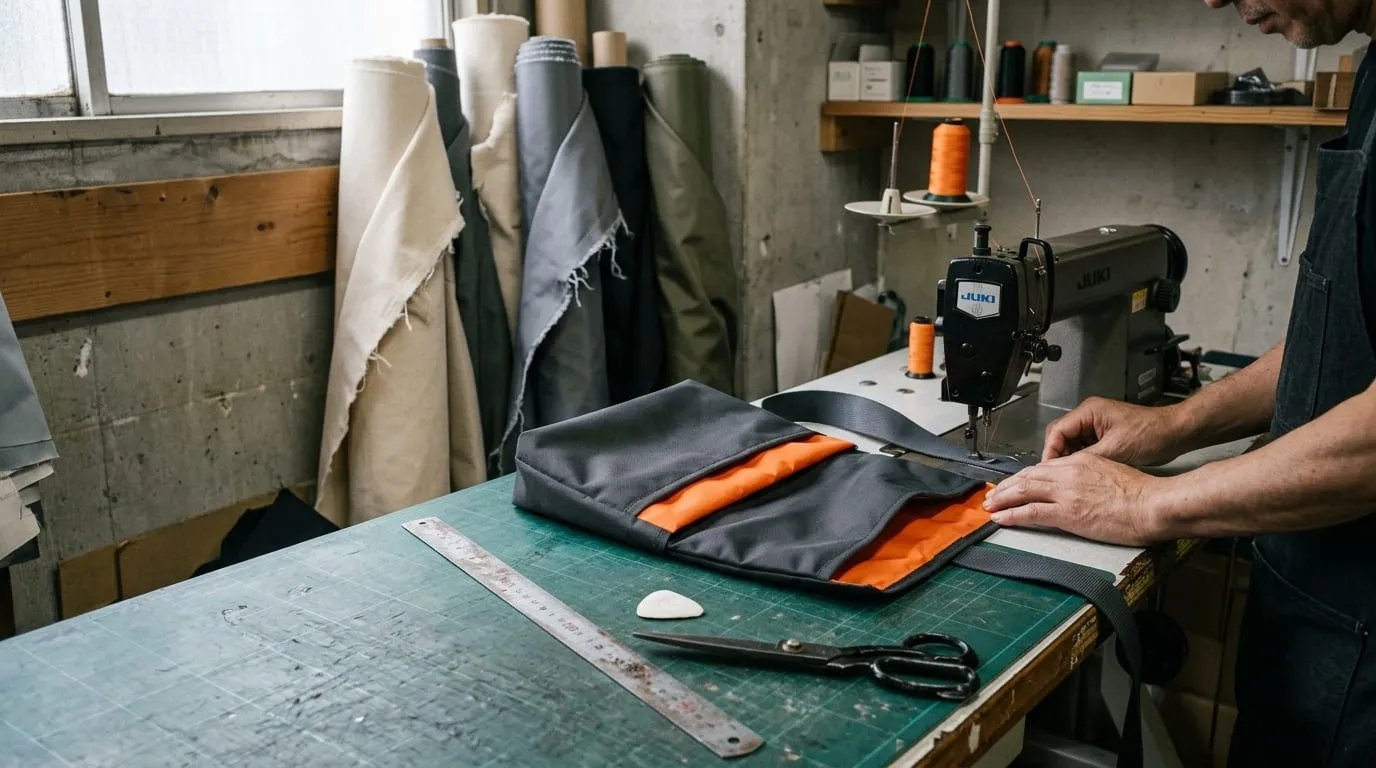
Everyone in Japan knows Porter, and nobody remembers seeing an advert for it. Behind the brand is a Tokyo family firm that has applied two simple rules for decades: no advertising budget, no price cuts. Where those rules come from, what they protect, and what a foreign brand can take from them before opening in Japan.
The bag you recognise before you read the label
Walk through Shibuya on a Saturday and count them. Dark nylon, an orange lining, zips that sit flat. That is the TANKER, in production since 1983 and barely changed since. No visible logo: a small woven tag outside, another stitched inside, nothing more.
That bag is the most visible product of a company that chose not to chase visibility. Yoshida & Co., known across Japan as Yoshida Kaban, has its head office in Higashi-Kanda, in Chiyoda ward, a few minutes' walk from Akihabara. The house was founded in 1935 by Yoshida Yoshikura, incorporated in 1951, and launched its own brand, Porter, in 1962.
Ninety years of history, four generations at the head of the company, and one instruction from the founder that explains almost everything else.
A Kanda workshop, 1935
It starts with a craftsman setting up on his own at twenty-nine. In 1935, Yoshida Yoshikura opened his bag workshop in Kanda, a district of merchants and craftsmen in central Tokyo. He was not trying to build a brand. He made bags that had to survive everyday use, and the reputation he earned came down to two words: solid and practical.
It took twenty-seven years for that reputation to carry a name. In 1962 the workshop launched Porter, after the hotel porter, whose job is to carry other people's luggage, and to do it well. Until then the house had made bags for others and sold wholesale. With Porter, it finally signed what it made.
Two lines then fixed the brand in place: the TANKER in 1983, inspired by flight jackets, and LUGGAGE LABEL in 1984. The YOSHIDA brand followed in 2004. In 2025 the house turned ninety. Four generations have led it.
One instruction, two rules
The founder left an instruction that comes up in every interview with his successors: never let the craftsmen disappear. Yoshida owns no factory. The house designs, then entrusts production to independent Japanese workshops it has worked with for years, and a repair goes, wherever possible, back to the workshop that made the bag.
Two rules follow from that instruction and have never moved: no advertising, and no price cuts.
Every yen spent on a campaign or given away in a sale is a yen that never reaches the workshop.
That arithmetic is what turns a stance into a strategy. On a bag sold at full price, part of the money goes back to the workshop that made it. Paying for a campaign, or cutting prices for a promotion, means taking that money from somewhere, and in this model it would come from the workshops. In other words, it would break the founder's instruction. So the house spends nothing on being seen, and nothing on looking cheap.
Yoshida Teruyuki, the third president, wrote a book about it, 吉田基準, "the Yoshida standard". The phrase did not come from a marketing department: the craftsmen themselves coined it to describe the level the house expects. His motto, 利は元にあり, says that profit is made at the source, in the making, not in the selling.
What the numbers say
A company of around three hundred people that has built one of the most recognised bag brands in the country.
- Around 20.1 billion yen in revenue for the year to May 2025, with 303 employees, according to the company profile Yoshida publishes on Mynavi.
- Around two million pieces a year, across close to 4,000 references, from a small pouch at a few thousand yen to an executive briefcase, according to the company.
- More than forty shops under its own name, in Japan and abroad, plus a network of authorised retailers and department stores, where prices stay the same as in its own shops.
For scale: the Japanese retail market for bags and small leather goods reached 1.474 trillion yen in fiscal 2023, up 11.2 per cent year on year, as foreign visitors returned, according to Yano Research Institute. The institute forecast 1.505 trillion yen for fiscal 2024. In a market that size, dominated by the large foreign luxury houses, a Japanese family firm that holds its prices has a place of its own.
Why it holds
Porter's prices have risen in recent years, and the brand still runs no seasonal markdown. That discipline buys it three things.
- Scarcity without theatre. Nobody queues outside a Porter shop, and nobody needs to. The product is there, at the same price everywhere. The value sits in the price and in the workshops' skill, not in a calendar of limited drops.
- Trust from the trade. A department store or a retailer knows the price will not be slashed two months later, somewhere else, in front of them. That is exactly what Japanese retailers hold against brands used to discounting.
- The right to wait. Unlisted and still family-run, the house has no shareholders asking for quarterly growth. It can turn down volume the workshops could not keep up with. Growth is a consequence, not the goal.
Two problems: the name abroad, the age of the craftsmen
The first problem played out outside Japan. In the late 1980s, Yoshida gave a Taiwanese commercial partner the right to register its trademarks outside Japan. The PORTER name was then filed in more than twenty countries and regions, including China, the United States and Europe. When the house tried to buy those rights back in the early 2000s, they had already been sold to another company. The result: in much of the world, Yoshida does not control the name of its own brand.
The answer came in 2004, with a brand carrying the family name: YOSHIDA, first designed for collaborations with foreign brands, then developed with its own designs from 2008. A name nobody else can hold.
The second problem is demographic. A model that relies on independent workshops relies on the craftsmen in them, and they are ageing. The house trains young people, keeps volumes at a level the workshops can absorb, and repeats that its growth will not come at the cost of their disappearance.
The current chapter
Since 2020 the fourth generation has been in charge. Yoshida Yukihiro, who trained in bag making in Italy, has brought the historic motto back to the front, 一針入魂, "a soul in every stitch", while running a very current agenda: stronger online sales, digital tools inside the company, and a new brand, POTR, with a more graphic language than Porter, meant as a second pillar.
Put end to end, the sequence makes sense: build the product and the reputation at home for decades, keep control of distribution, protect the workshops and the price, and only then turn to the rest of the world with names you fully own.
Our reading
Six lessons worth taking, and one that cannot be copied.
- Distribution makes the brand. Porter is desirable because you find it in chosen places, at the same price everywhere. A brand that enters Japan by letting every possible reseller sell it gains volume and loses the only asset it had. When a foreign brand was fashionable for two seasons and then disappeared, the answer is often in its list of resellers.
- Price is a promise. Refusing discounts keeps the workshops alive, and the workshops justify the price. Break that loop once, for a single sale season, and it never comes back.
- Craft needs a sentence. 一針入魂 explains a product without a single adjective, and the craftsmen found it, not an agency. A brand arriving in Japan without a sentence like that arrives without a reason to be remembered.
- The home market is the laboratory. Porter built its reputation in Japan for decades before looking elsewhere. For a foreign brand, Japan deserves the same seriousness: it is a market where you make a model hold, not a test bed.
- The channel matters more than the address. In Japan, being in the right department stores and with the right retailers is not a compromise, it is a mark of legitimacy. Forty well-chosen points of sale beat one spectacular flagship.
- Protect your name before you arrive. The story of the PORTER name abroad is the most expensive lesson in the file. Registering your trademark in Japan and in neighbouring countries before signing with a partner costs little. Getting it back later can take years, or never happen.
And what cannot be copied: ninety years. The trust attached to that bag was not bought, it built up over generations that refused shortcuts. When you land in Tokyo with a launch calendar, that is the one part you cannot speed up. What you can do is choose your channels, your price and your rules from day one, and that is what we prepare with brands that want to open in Japan.
Sources
- Wikipedia (Japanese), 吉田カバン: founded 1935, incorporated 1951, PORTER 1962, TANKER 1983, LUGGAGE LABEL 1984, YOSHIDA 2004, history of the PORTER name abroad
- Yano Research Institute, press release on the Japanese bag and small leather goods market, fiscal 2023 and 2024 forecast
- Mynavi 2027, Yoshida company profile: revenue and headcount
- Nikkei, 2017, interview with Yoshida Teruyuki on refusing to cut prices
- TV Tokyo, Cambria Kyuden, July 2012, profile of Yoshida Teruyuki and the house
- Nippon Jitsugyo Publishing, presentation of the book 吉田基準 (no advertising, no discounts, repairs by the original workshop)
- Senken Shimbun, July 2023, interview with Yoshida Yukihiro on POTR and protecting the craftsmen
Frequently asked questions
Does Porter really never advertise?
For decades the house has applied two rules that come from its founder's instruction: no advertising budget, no price cuts. The product, the shops and the retailers do the work a campaign would do elsewhere.
Who makes Porter bags?
Yoshida owns no factory. The house designs its bags and entrusts production to independent Japanese workshops it works with over the long term. Repairs go, wherever possible, back to the original workshop.
How big is Yoshida?
Around 20.1 billion yen in revenue for the year to May 2025, with 303 employees, according to its company profile. The house says it makes around two million pieces a year and has more than forty shops under its own name.
How big is the Japanese bag market?
About 1.474 trillion yen in retail sales in fiscal 2023, up 11.2 per cent year on year, according to Yano Research Institute, which forecast 1.505 trillion yen for fiscal 2024.
Why is the TANKER so recognisable?
It has been made since 1983 with almost no changes: nylon, orange lining, a woven tag, no visible logo. Continuity, more than novelty, made it a reference.
What are the YOSHIDA and POTR brands?
YOSHIDA, launched in 2004, was born partly because the PORTER name had been registered by others in many countries. POTR is the newer brand, with a more graphic language, developed by the fourth generation as a second pillar.
What does 一針入魂 mean?
"A soul in every stitch". It is the house's historic motto, taken up again by the current president, and the shortest way to explain the price of a Porter bag.
What should a foreign brand entering Japan take from this?
Three things: choose your distribution channels carefully rather than multiplying resellers, hold your price from day one, and register your trademark in Japan and neighbouring countries before signing with a partner.

The letter
土台 Journal, every week.
The restaurants and shops that have just opened in Tokyo, found on foot. Past issues are readable in full, with no sign-up.
Read next
Case study
Japan's premium milk bread bubble, and what it cost
In 2013 an Osaka bakery sold one loaf of bread. Five years later Japan had hundreds of shops just like it. Then the closures started.
Case study
Blue Bottle in Japan: the rise of a myth, and what it cost
28 cafés, five-hour queues on day one, a loss-making sale eleven years later. What that trajectory really says about the Japanese market.
Practical guide
Japan's tax-free shopping changes on 1 November 2026: what retailers need to know
On 1 November 2026, Japan switches to a refund system for tax-free shopping. Tourists pay the tax at the till and get it back once customs has checked their purchases. A shop, a department store or a foreign brand that sells to visitors will have to change how it prices, refunds and reports each sale.
A guide informs. A project needs a closer look.
Let's look at yours.
Book a 30-min callA costing rather than a conversation? Request a quote